


Diaa Al-Awadi
The Doctor Who Turned Food Into a Question About the Body
Some doctors become known because they master the rulebook. Diaa Al-Awadi became impossible to ignore because he walked deep inside that rulebook, understood its power, saw its limits, and then came out asking a question that many people were not ready to hear: what is the body trying to say before disease gets a name?
The Real Beginning of the Story
The story of Diaa Al-Awadi does not begin with the controversy. It does not begin with the social media storm, the food lists, the television appearances, or the sudden and deeply unsettling end of his life in Dubai.
It begins with a physician trained in intensive care, a place where the human body does not politely follow textbook categories.
In the ICU, the body does not arrive as a neat chapter called cardiology, nephrology, gastroenterology, endocrinology, or psychiatry. It arrives as a whole system in trouble.
Heart. Liver. Kidneys. Gut. Immune response. Blood pressure. Oxygen. Drugs. Food. Inflammation. Stress. Survival. All standing in the same room.
Once a doctor has seen the body from that angle, it becomes very hard to believe that chronic illness is only a collection of disconnected labels.
Who Was Diaa Al-Awadi?
The full documented name appears in public academic and official records as Diaa Eldin Shalaby Mohamad El-Awady, with close spelling variants such as Diaa Eldin Shalaby Mohamed AlAwady. He was an Egyptian physician associated with Ain Shams University Faculty of Medicine in Cairo, with a professional background in anesthesiology, intensive care medicine, and pain management.
His academic record includes a registered thesis under his name in the Ain Shams University research database titled Study of effect of low dose hydrocortisone on reversal of micro-albuminuria as an early predictor for sepsis and multiple organ failure in intensive care patients.
A later academic publication also lists Diaa Eldin Shalaby Alawady in the Anesthesiology, Intensive Care and Pain Management Department, Faculty of Medicine, Ain Shams University.
Several media and biographical sources report that Diaa Al-Awadi was born around 1979 into an academic Egyptian family and graduated from Ain Shams Faculty of Medicine. Early-life details such as exact graduation year, high school records, and some timeline points still require tighter primary documentation before being treated as fully verified historical facts.
That distinction matters. The biography of Diaa Al-Awadi should not be written like fan fiction. It should not be flattened into an institutional press release either. He deserves something more difficult and more honest: a biography that understands both the man and the fracture he created in how thousands of people began to think about food, illness, and the human body.
The ICU Lens: Why Diaa Al-Awadi’s Background Matters
The easiest mistake is to describe Diaa Al-Awadi as a nutrition figure.
That is too small.
He was not originally known because he told people to eat one thing and avoid another. That came later. Before Tayibat became a public system, before the arguments, before the clips, before the cheering followers and furious critics, there was a doctor trained to watch the body under pressure.
Intensive care changes how a physician sees life. An ICU doctor does not get the luxury of pretending that organs live in separate apartments. A failing kidney may be talking to the heart. A liver under stress may be part of an inflammatory storm. A gut problem may not stay in the gut. A patient’s numbers may look like a spreadsheet, but the body is not a spreadsheet.
It is more like a city at night: power lines, traffic, emergency sirens, water systems, silent neighborhoods, hidden fires.
Diaa Al-Awadi seemed to understand the body as a living system, not a pile of parts. That sounds obvious until you watch how modern health culture often speaks.
One doctor for the stomach. One doctor for the heart. One doctor for sugar. One doctor for mood. One doctor for immunity. One supplement for energy. One protein target for muscle. One calorie app pretending it has decoded biology because it can count almonds.
The body, meanwhile, is quietly rolling its eyes.
In his public appearances and Tayibat documentation, one repeated idea was that many chronic disease patterns may begin with repeated internal disturbance, often showing early warnings through digestion, reflux, bloating, heaviness, or irritable bowel symptoms before branching into different pathways depending on the person.
The disease name is not always the beginning of the story. Sometimes, it is the last chapter of a much longer book.
The Question That Made Diaa Al-Awadi Dangerous to Boring Thinking
Most nutrition conversations begin with a comfortable question: what does this food contain?
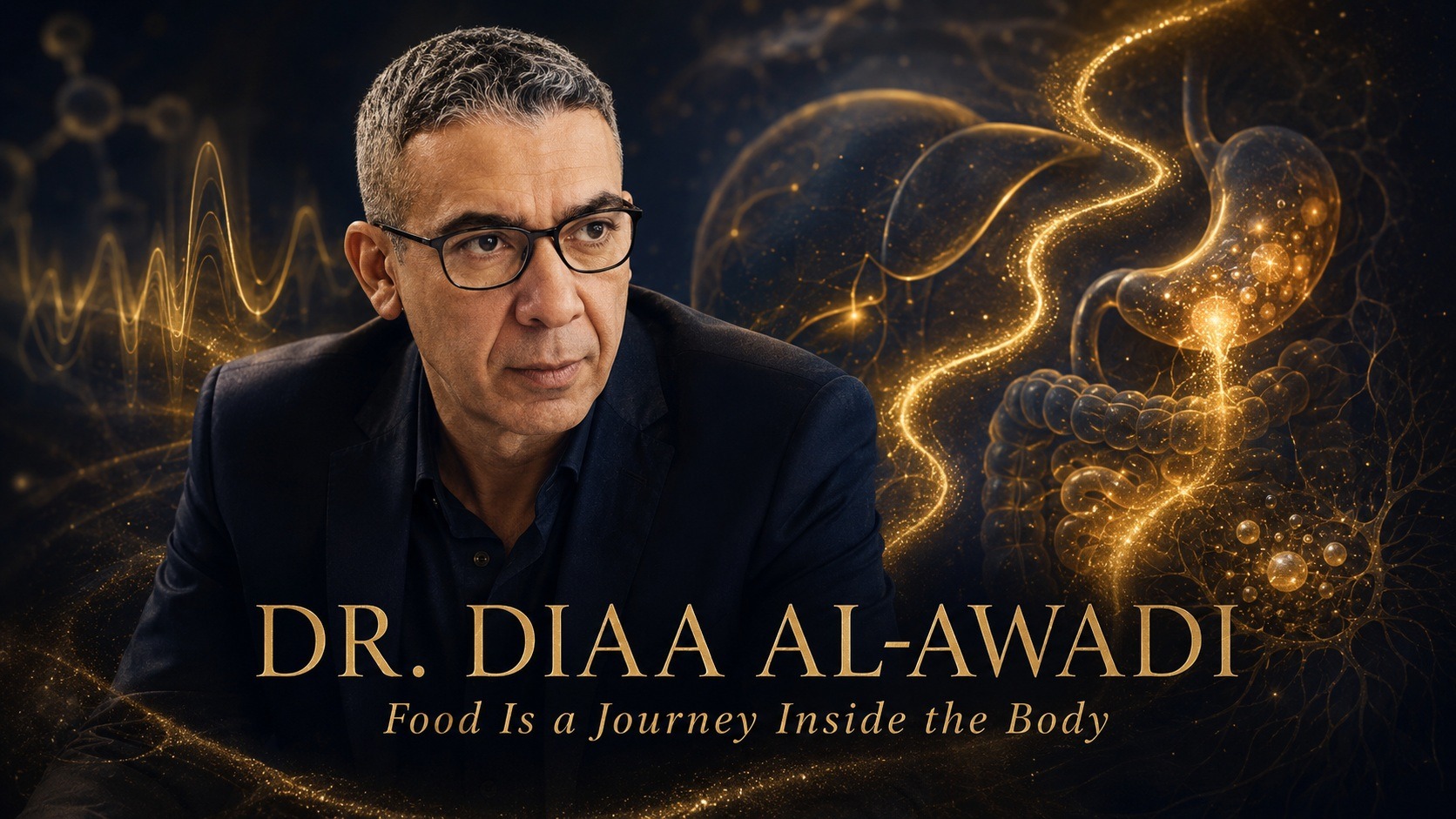
Protein? Calcium? Fiber? Vitamins? Omega-3? Antioxidants? Low calories? High protein? A leaf on the package? A smiling athlete on the label?
Wonderful. The food has entered the wellness Olympics.
Diaa Al-Awadi was not impressed.
His question was not only what food contains. His question was sharper:
What does this food do once it enters the body?
That one shift changes everything. The body does not eat marketing. It does not eat a nutrition label. It does not eat the reputation of a food. It eats the entire journey.
Texture. Density. Digestion. Stomach response. Gut movement. Immune reaction. Insulin signaling. Liver workload. Sleep effect. Energy after eating. Mood after eating. The cost of repetition over one year, three years, five years.
In Tayibat thinking, food is not just a substance. Food is an event. It enters. It moves. It signals. It burdens. It passes quietly or makes noise. It leaves the body calmer, or it starts a committee meeting inside the organs.
And honestly, the body has enough meetings already.
This is why the philosophy of Diaa Al-Awadi was not simply a diet. It was a challenge to the lazy habit of judging food by its résumé.
Not every benefit is worth the internal cost.
1. Diaa Al-Awadi Saw the Body as One System, Not Separate Departments
One of the most powerful ideas behind Diaa Al-Awadi was that the body should not be understood as isolated organs waiting in separate medical departments.
The gut does not live alone. The liver does not work alone. The immune system does not flare in a vacuum. Insulin does not exist only inside a diabetes textbook. Sleep is not separate from digestion. Mood is not always separate from what the body is carrying.
This does not mean every symptom has one simple food cause. That would be too easy. It means the body is a network. And when a network is disturbed every day, the warning may appear in one place before the deeper cost appears somewhere else.
This is why Diaa Al-Awadi often returned to digestion as an early alarm system. Not because everything is only in the stomach, but because the digestive system is the first gate where the outside world becomes an internal event.
Food enters the mouth. It meets acid. It changes texture. It talks to enzymes. It passes through the gut. It sends signals. It reaches the liver. It touches immunity. It affects energy, storage, sleep, and sometimes mood.
That is not just eating. That is biology opening the front door.
2. Diaa Al-Awadi Asked What Food Does, Not Just What Food Contains
This may be the most important shift in the entire Tayibat philosophy.
Mainstream nutrition often looks at food through composition: protein, carbohydrates, fat, micronutrients, calories, and fiber.
Tayibat looks at food through consequence.

- Did it pass quietly?
- Did it irritate?
- Did it burden digestion?
- Did it create immune noise?
- Did it disturb insulin signals?
- Did it make the body sleepy, inflamed, congested, foggy, heavy, restless, or hungry again too soon?
This is not a small stylistic difference. It is a different map.
The label says
This food contains protein. This food is rich in calcium. This food is natural.
Tayibat asks
What did this protein source cost the body? Did the body accept the whole food? Natural for whom, in what form, in what quantity, repeated how often?
That is why Diaa Al-Awadi became so disruptive. He refused to let a food hide behind one good feature.
Food is not a résumé. Food is behavior. And the body is the judge.
3. Diaa Al-Awadi Treated Symptoms as Signals Before Labels
Modern medicine is very good at naming things. Sometimes that saves lives.
A correct diagnosis can be the difference between chaos and direction. A medication can stabilize a dangerous condition. A surgical decision can be necessary. A lab test can reveal something invisible. A specialist can see what others miss.
This biography is not here to pretend otherwise.
But Diaa Al-Awadi focused on a gap many patients feel deeply: what happens before the disease gets its official name?
Before diabetes becomes a diagnosis. Before reflux becomes a long-term prescription. Before the kidney number becomes a panic. Before the immune condition gets a label. Before fatigue becomes a lifestyle. Before bloating becomes personality.
The body often speaks before the file speaks. It may speak through heaviness after meals, reflux, poor sleep, fog, repeated congestion, strange fatigue, digestive discomfort, mood shifts, or that feeling people describe as “I do not feel like myself.”
The Tayibat lens does not treat every signal as a catastrophe. It treats the signal as information.
And this is one reason people loved Diaa Al-Awadi. He gave meaning to symptoms that many people had been trained to ignore, tolerate, or suppress.
What is the body reacting to? What is the body carrying? What is the hidden cost of this daily habit? What happens after repetition?
4. Diaa Al-Awadi Saw Tayibat as More Than a Diet
Calling Tayibat System a diet is like calling a courtroom a chair collection. Technically, yes, there are chairs in the room. But that is not the point of the place.
Tayibat includes allowed and forbidden foods. Those lists are visible, memorable, and easy to argue about. But the deeper idea is not a menu. It is a way of reading the body.
Diaa Al-Awadi separated the theory from the system.
The theory
The body has an internal capacity to repair when harmful daily inputs are removed.
The system
Tayibat is the practical application through food selection, food restriction, and the attempt to reduce internal burden.
The deeper claim
The body is not stupid, lazy, or your enemy. It may be overwhelmed.

In the framework of Diaa Al-Awadi, the first move is not always to add more things. Not more powders. Not more capsules. Not more hacks. Not more trackers. Not more miracle drinks.
The first move is removal.
Remove the inputs that confuse the body. Remove what irritates digestion. Remove what burdens immunity. Remove what turns food into internal noise. Then watch what the body does when it finally gets a quieter room to work in.
5. Diaa Al-Awadi Made the Food List Less Important Than the Method
Many people talk about Diaa Al-Awadi as if the scandal was the food list: eggs, chicken, white flour, milk, beans, vegetables, and other foods mainstream nutrition culture often treats as safe, useful, or ideal.
But the real scandal was not the list. The list was just the loud part.
The real scandal was the method.
Diaa Al-Awadi refused to let a food win because it had one good nutrient. He did not treat food like a politician who can point to one charity event and ask everyone to forget the rest of the record.
He asked about the full effect. A food could be high in protein and still be costly. A food could be rich in calcium and still create internal noise. A food could be plant-based and still not pass quietly through the body. A food could be traditional, popular, beloved, and still leave the body paying a hidden bill.
This is where Tayibat becomes especially interesting for an American audience. American wellness culture is obsessed with branding food as clean, high-protein, gut-friendly, heart-healthy, natural, plant-based, low-fat, high-fiber, keto, paleo, organic, grass-fed, gluten-free, dairy-free, sugar-free, guilt-free, joy-free, and occasionally flavor-free.
The question of Diaa Al-Awadi cuts through that entire circus:
What happened after you ate it?
Did your stomach relax or file a complaint? Did your energy rise or crash? Did your sleep improve or turn into a hostage situation? Did your body feel clear or foggy? Did your gut move like a river or like traffic in Cairo at 5 p.m.?
That is not a cute wellness question. That is a different medical-food philosophy.
6. Diaa Al-Awadi Believed the Body Needs a Quieter Environment
At the heart of the thought of Diaa Al-Awadi was a radical respect for the body.
Not a sentimental respect. Not the Instagram version where someone lights a candle and whispers “I honor my vessel” while eating a snack bar with 37 ingredients.
A biological respect.
He saw the body as a system constantly trying to repair, clean, balance, rebuild, and defend. The body is not waiting for permission to work. The immune system works. The liver works. The gut works. The cells work. The kidneys work. The nervous system works. The endocrine system works.
Even when you are asleep, the body is running a night shift that deserves hazard pay.
The argument of Diaa Al-Awadi was that the problem is not always that the body lacks intelligence. The problem may be that we keep interrupting that intelligence with the wrong inputs.
This is the philosophical engine of Tayibat: the body is not an enemy to silence. It is a messenger to understand. Symptoms are not always random disasters. They can be warning lights.

And if you keep covering the warning light with tape, you may feel calm for a while, but the engine is still smoking.
That is why digestive signals mattered so much in his model. Gas, reflux, bloating, heaviness, strange fatigue after meals, disturbed sleep, repeated cravings, and mood shifts were not treated as little annoyances floating in space. They were clues.
In the Tayibat view, the gut is often the first place where the body whispers before it screams.
7. Diaa Al-Awadi Changed the Emotional Language of Chronic Illness
People did not love Diaa Al-Awadi only because he gave them food rules. Food rules are everywhere. The internet has enough diets to make a salad cry.
They loved him because he gave them a story about their bodies that felt alive.
Many patients with chronic conditions know the modern medical routine well: here is the test, here is the number, here is the medication, come back in three months. If the number is worse, we increase the dose. If another number appears, we add another medication. Please continue indefinitely and try not to ask too many existential questions in the hallway.
That routine may be medically necessary in many cases. It may save lives. It may stabilize people. It should not be mocked or casually abandoned.
But emotionally, it can leave people starving for meaning.
Diaa Al-Awadi stepped into that hunger. He gave people a language for the body’s signals. He told them the body was not stupid. He told them symptoms might have a root. He told them food was not innocent just because it was famous. He told them the body might be capable of more repair than they had been taught to imagine.
That is a deeply attractive message, especially in a world where many people feel like their bodies have become expensive, confusing, and permanently under maintenance.
Diaa Al-Awadi made them feel that the body was not a broken machine. It was a wise organism asking for the right environment.
The Egyptian Media Moment: Diaa Al-Awadi on Bab El Khalq
The ideas of Diaa Al-Awadi did not explode only because of social media. They crossed into a wider public space through Egyptian television.
One of the most important media moments was his appearance on Bab El Khalq, an Egyptian TV program hosted by Mahmoud Saad, a well-known Egyptian journalist and television presenter.
For an American reader, think of this as the moment when a niche medical philosophy left the corner of the internet and entered the living room.
Before that, Diaa Al-Awadi had an audience. After that, he had a movement.
The show gave him access to a broader Egyptian audience that was already tired, curious, skeptical, hopeful, and deeply frustrated with the endless management of chronic disease.
And he knew how to speak to that audience. He did not sound like a guideline PDF. He did not sound like a hospital brochure. He did not speak in the cold, polished dialect of institutional medicine.
He spoke like a man who had seen the body from the inside and was angry that people had been taught to ignore its signals.
That kind of voice travels fast, especially when people are sick, tired, and quietly wondering whether the system has been managing their disease without ever explaining their body.
The YouTube Archive: Diaa Al-Awadi Becomes a Movement
The official YouTube presence of Diaa Al-Awadi became one of the main archives of his public teaching.

This matters because he was not only a doctor in a clinic. He became a media figure, a teacher, a disruptor, and for many followers, a kind of interpreter of the body.
The clinic visit became only one layer of the phenomenon. The bigger clinic was digital.
People watched him while cooking, commuting, resting, worrying, arguing in family WhatsApp groups, and quietly reconsidering foods they had eaten for decades without asking what those foods were doing inside them.
This is one reason his influence was so strong. He did not simply offer instructions. He offered a new lens.
And once someone sees food through a different lens, it is hard to unsee it. A glass of milk is no longer just milk. An egg is no longer just protein. Chicken is no longer just lean meat. White bread is no longer just bread. A meal is no longer a plate.
It is a journey. A signal. A cost. A conversation with the body.
That is why Tayibat System did not behave like a normal diet trend. It behaved like a worldview.
Why Institutions Feared Diaa Al-Awadi
The same qualities that made people love Diaa Al-Awadi also made institutions alarmed.
He did not speak cautiously. He did not stay inside one narrow specialty lane. He challenged mainstream assumptions across diabetes, digestion, immunity, cancer, kidney disease, heart disease, hormones, food, and medication.
For medical institutions, that is not a small matter.
In March 2026, Egyptian medical and media sources reported that the Egyptian Doctors Syndicate disciplinary process led to the removal of Diaa Al-Awadi from its records, and Egypt’s Ministry of Health announced an administrative closure order for a medical facility owned by Diaa El-Din Shalabi Mohamed El-Awady in Nasr City.
Ahram Online reported that the closure and license-related action followed accusations of spreading misleading and scientifically unproven medical information on social media.
On March 11, 2026, Egypt’s Supreme Council for Media Regulation also issued decisions connected to the media appearance of Diaa Al-Awadi, as part of the broader public controversy around his medical statements. Later, after his death, the media regulator went further and banned circulation of his recorded visual, audio, and written content, citing public health risks.
This was no longer just a debate. It was a collision: a doctor with a growing public movement, a medical institution warning of danger, a media system stepping in, followers defending him fiercely, critics calling him reckless, and patients caught between hope, fear, trust, and confusion.
Diaa Al-Awadi became a battlefield for a larger question: who gets to define medical truth when patients no longer feel fully seen by the system?
The Controversy Should Not Erase the Question
A mature biography does not turn Diaa Al-Awadi into a saint. It also does not reduce him to a warning label.
Both are lazy.
The saint version is too clean. The villain version is too convenient. The real man was more complicated, more electric, more disruptive, and more important than either cartoon.
Some of his claims were challenged by official bodies. Some of his language was considered too absolute by critics. Some institutions argued that his public medical advice could put patients at risk. Those facts belong in the biography.
But another fact belongs there too: Diaa Al-Awadi touched a nerve that mainstream medicine often fails to touch.

He spoke to the patient who is tired of being managed. The patient who wants to know why. The patient who feels that the body is sending messages nobody has time to translate. The patient who is told that chronic disease is normal with age, family history, lifestyle, stress, and a shrug.
Diaa Al-Awadi challenged the shrug.
That does not mean every answer he gave should be accepted without scrutiny. It means the question he asked was powerful enough to survive the controversy.
The Father, the Turning Point, and the Search for Root Cause
In the Bab El Khalq documentation and internal project archive, Diaa Al-Awadi connected part of his intellectual shift to his father’s health journey.
He spoke about his father being diagnosed with colon cancer and described a longer history of health problems including hypertension, diabetes, artery issues, cholesterol, and sleep problems. He said he began applying his dietary approach with his father years before the public explosion of Tayibat.
Whether every detail in that personal narrative can be independently verified is a separate archival question. But biographically, it reveals something important.
For Diaa Al-Awadi, Tayibat was not only theory. It was personal.
It came from the place where doctors often become more dangerous to old assumptions: family pain.
A doctor can discuss disease clinically all day. But when disease enters the family, the question changes. It is no longer only: what does the protocol say? It becomes: why is this happening to someone I love?
That emotional shift can break open a mind. Sometimes it produces wisdom. Sometimes it produces obsession. Often, with figures like Diaa Al-Awadi, it produces both.
He began asking whether chronic illness was truly a collection of separate conditions, or whether many diseases were downstream effects of repeated internal disturbance. That question would later become central to his public work.
Tayibat vs. Mainstream Nutrition: The Real Difference
Mainstream nutrition often asks: what does this food contain?
Tayibat asks: what does this food make the body do?
That is the real difference.
Eggs
A common nutrition conversation might say: eggs are protein. Tayibat asks: what is the internal cost of that protein source?
Milk
A standard health label might say: milk contains calcium. Tayibat asks whether the body accepted the whole milk journey.
Vegetables
A wellness trend might say vegetables are always healthy. Tayibat asks: which vegetables, in what form, for which body, and with what after-effect?
This is why the food philosophy of Diaa Al-Awadi cannot be understood through standard diet categories. It is not carnivore. It is not vegan. It is not keto. It is not intermittent fasting dressed in Egyptian clothes. It is not calorie counting. It is not simply low-carb, high-carb, low-fat, or high-protein.
It is a reading system. Food is judged by its journey. The body is judged by its signals. The meal is judged by its after-effect. And the repeated habit is judged by the bill it leaves behind.
Why Readers Should Care About Diaa Al-Awadi
To an audience outside Egypt, Diaa Al-Awadi may sound like a controversial nutrition rebel from Egypt. That is true, but incomplete.

He belongs to a much larger global moment.
Across the United States and beyond, millions of people are also asking why they feel bloated after supposedly healthy meals, why they crash after breakfast, why high-protein diets do not always make them feel better, why gut problems are everywhere, why sleep is broken, why autoimmune conditions are rising, why obesity and fatigue can coexist with obsessive wellness culture, and why chronic disease management often feels like living inside a subscription plan nobody asked for.
The language of Diaa Al-Awadi came from Egypt. But the frustration he answered is international.
The modern human body is drowning in advice and starving for interpretation.
Eat more of this. Eat less of that. Track this. Avoid that. Take this. Supplement that. Trust the label. Fear the label. Do fasting. Stop fasting. Go plant-based. Go animal-based. Eat like your ancestors. Eat like a biohacker. Eat like a monk. Eat like a billionaire tech founder who has not looked happy since 2018.
Somewhere in that mess, Diaa Al-Awadi asked a brutally simple question:
What did the food do to the body?
That question travels well because it is not Egyptian only. It is human.
The Sudden Death of Diaa Al-Awadi in Dubai
The final chapter of Diaa Al-Awadi made the story even more intense.
In April 2026, Egyptian and regional media reported his death in Dubai. Egypt’s Ministry of Foreign Affairs said it followed the case through the Egyptian consulate after being notified by Dubai authorities. Official reports citing the UAE medical findings said the death was natural, caused by a sudden cardiac event, with no criminal suspicion.
That is the official account. It must be stated clearly.
But the emotional truth of the story is more complicated. For many followers, the death of Diaa Al-Awadi did not feel like an ordinary death. It came after a sharp institutional escalation, the loss of his professional standing, the closure of his clinic, the ban on media appearances, and a period of intense public conflict.
A man at the center of a medical and media war. Then a sudden death in a hotel room outside Egypt. Then official statements. Then grief. Then suspicion. Then arguments. Then people trying to decide what kind of story they had just witnessed.
No responsible biography can claim murder without evidence. But no honest biography can pretend the public did not feel the shadow.
The cleanest way to say it is this: officially, Diaa Al-Awadi died of natural causes following a sudden cardiac event, with no criminal suspicion according to official statements. In the memory of many followers, however, his death remained surrounded by unanswered emotional questions because of the timing, the pressure around him, and the unresolved weight of the conflict he left behind.
That is not conspiracy writing. That is history with a pulse.
After His Death, the Silence Got Louder
Usually, when a controversial figure dies, the argument fades.
With Diaa Al-Awadi, it grew.
Followers returned to his videos. Critics intensified their warnings. Supporters treated him as a man who paid the price for speaking differently. Opponents saw his case as proof that public medical speech must be tightly controlled.
The internet did what the internet does best: it turned grief into a courtroom with terrible lighting.

Then, on May 3, 2026, Egypt’s Supreme Council for Media Regulation directed media outlets and digital platforms under Egyptian media law not to publish, broadcast, circulate, or re-circulate recorded visual, audio, or written materials by the late Diaa Al-Awadi, citing risks to public health.
That decision is historically important because ordinary people do not usually receive posthumous media bans. Whether one agrees with the decision or not, it proves the scale of the phenomenon.
Diaa Al-Awadi was not merely a physician with unusual dietary views. He became a public force large enough that the state, the medical establishment, the media system, patients, critics, and followers all had to respond.
That is why his biography matters. Not because he was universally accepted. He was not. Not because every claim he made has been settled. It has not. But because he shifted the conversation.
What Tayibat System Preserves From Diaa Al-Awadi
Tayibat System does not exist to turn Diaa Al-Awadi into a statue. Statues are usually for people nobody wants to argue with anymore.
Diaa Al-Awadi should be argued with, studied, understood, challenged, defended, refined, and remembered. But he should not be flattened.
The deepest thing Tayibat System preserves from him is not a food list. It is the lens.
- The body is intelligent.
- Food is an internal journey.
- Disease is often a late signal, not the first event.
- Symptoms deserve attention before they become labels.
- A benefit on paper may carry a cost in practice.
- The gut is not a side character.
- The cell needs environment before instructions.
- The question is not only what food contains, but what food does.
That lens is the legacy. And it is not small.
It changes how a person reads breakfast. It changes how a patient reads fatigue. It changes how a parent reads a child’s recurrent symptoms. It changes how a person reads sleep, mood, digestion, cravings, body heaviness, and that strange after-meal fog people joke about but rarely investigate.
Diaa Al-Awadi made the ordinary meal suspicious in the best possible way. Not paranoid. Awake.
Was Diaa Al-Awadi Ahead of His Time?
That is the question people will keep asking.
Maybe the most honest answer is: partly, and dangerously so.
He was ahead of common nutrition talk when he refused to judge food by one nutrient. He was ahead of lazy wellness branding when he asked what happened inside the body after the meal. He was ahead of many public health conversations when he treated chronic illness as a system problem rather than only a set of separate labels.
But being ahead does not make a person automatically right in every claim. It does not excuse overstatement. It does not remove the need for evidence, patient safety, medical follow-up, and serious critique.
This is the tension that makes Diaa Al-Awadi so difficult to write about.
He cannot be responsibly turned into a flawless medical prophet. He also cannot be honestly dismissed as a simple internet problem.
His influence came from the uncomfortable space between those two errors.
He made people ask: what is the body reacting to, what is the body carrying, what is the hidden cost of this food, and what happens after repetition?
That is a major shift. And major shifts are never tidy. They come with resistance. They come with mistakes. They come with exaggeration. They come with defenders who go too far and critics who refuse to listen.
Diaa Al-Awadi lived inside that storm. Then he died inside an even bigger one. But the question he left behind did not die.

Short Timeline of Diaa Al-Awadi
- Academic and medical foundation: He was associated with Ain Shams University Faculty of Medicine and worked in anesthesiology, intensive care medicine, and pain management.
- Development of Tayibat thinking: His public philosophy shifted attention from what food contains to what food does inside the body.
- Media acceleration: Television and digital platforms helped his ideas reach a mass Egyptian audience.
- Institutional conflict: In March 2026, Egyptian medical and media authorities took formal action connected to his public medical claims.
- Death in Dubai: In April 2026, official Egyptian statements citing UAE medical findings said he died of natural causes following a sudden cardiac event, with no criminal suspicion.
- Posthumous media ban: On May 3, 2026, Egypt’s media regulator banned circulation of his recorded and written content, citing public health risks.
FAQ About Diaa Al-Awadi
Who was Diaa Al-Awadi?
Diaa Al-Awadi was an Egyptian physician associated with Ain Shams University Faculty of Medicine, with a background in anesthesiology, intensive care medicine, and pain management. He became widely known for the Tayibat System, a controversial food philosophy that shifted attention from what food contains to what food does inside the body.
What is the Tayibat System?
The Tayibat System is a medical-food philosophy inspired by Diaa Al-Awadi. It is not simply a diet or a calorie plan. It asks how food behaves inside the body: how it affects digestion, immune response, liver load, insulin signaling, energy, sleep, and the body’s internal burden.
Is Tayibat System a weight-loss diet?
No. Tayibat System may affect weight in some people, but weight loss is not the central idea. The deeper idea is reducing internal noise and helping the body work in a calmer environment by removing foods believed, within this philosophy, to carry a high internal cost.
Why was Diaa Al-Awadi controversial?
Diaa Al-Awadi was controversial because he challenged mainstream views about food, chronic disease, medication, diabetes, digestion, immunity, cancer, and several common foods. Egyptian medical and media authorities later took formal action against him, citing concerns about public health and scientifically unverified claims.
How did Diaa Al-Awadi die?
Official Egyptian statements citing UAE medical findings said Diaa Al-Awadi died in Dubai in April 2026 from natural causes following a sudden cardiac event, with no criminal suspicion.
Is this article medical advice?
No. This article is educational and historical. It explains the biography and philosophy of Diaa Al-Awadi and the Tayibat System. It does not provide medical advice, diagnosis, or treatment.
Closing: The Question That Remains
Diaa Al-Awadi was not just an Egyptian doctor with controversial opinions about food.
He was a physician who forced people to look again at the body. Not as a machine. Not as a lab report. Not as a list of organs waiting in separate departments. Not as an enemy to be silenced. But as a living, intelligent system that may be trying to repair itself while we keep feeding it noise.
His official story includes academic medicine, intensive care, Ain Shams University, public media, explosive popularity, institutional conflict, professional punishment, a sudden death in Dubai, and a legacy that became even louder after he was gone.
But beneath all of that, there is one question. The question that built Tayibat System. The question that made him loved. The question that made him feared. The question that still makes people uncomfortable because it moves responsibility from the clinic alone back into daily life:
What did the food do inside the body?
Not what did the label promise. Not what did the culture approve. Not what did the guideline simplify. Not what did the influencer sell. What did it do?
That is where the biography of Diaa Al-Awadi becomes bigger than one man. It becomes a new way to read the human body. And that is where Tayibat System begins.
Medical Note
This biography is written for educational and historical purposes. It does not provide medical advice, diagnosis, or treatment. No reader should stop, reduce, or change prescribed medication without direct supervision from a qualified physician. Tayibat System is presented here as a medical-food philosophy inspired by the work of Diaa Al-Awadi, and should be approached with awareness, documentation, and medical follow-up.
Related Reading
Suggested internal links for the Tayibat cluster:
Tayibat SystemAre Eggs Really a Perfect Protein?Do Eggs Cause Bloating?Do Eggs Cause Mucus?Heavy Stomach After Eating
Best Sources
- Ahram Online — Egypt shuts Nasr City clinic, revokes doctor’s license over misleading medical claims
A useful source for the March 2026 institutional action involving the Ministry of Health, the clinic closure, and the accusations of misleading and scientifically unproven medical information.
- Egypt State Information Service — Foreign Ministry follows up on Egyptian citizen’s death in Dubai
An official source for the Egyptian Foreign Ministry’s statement that the UAE medical report found the death natural, with no criminal suspicion, and due to a sudden heart event.
- Ahram Online — Egypt says no foul play suspected in death of Egyptian doctor in Dubai
A journalistic source summarizing the official medical report and the Foreign Ministry’s statement after Diaa Al-Awadi’s death.
- Ahram Online — Egypt bans circulation of late doctor Diaa Al-Awady’s content over public health risks
A source for the May 3, 2026 decision by Egypt’s Supreme Council for Media Regulation banning circulation of his recorded visual, audio, and written content.
- New Lines Magazine — An Egyptian Doctor’s Banned Viral Diet Outlives Him
A narrative source useful for understanding the broader public movement, the controversy around the diet, and the way his influence continued after his death.
https://newlinesmag.com/running-notes/an-egyptian-doctors-banned-viral-diet-outlives-him/
- QJM / Oxford Academic search — Diaa Eldin Shalaby Alawady
A useful academic lookup link for publications connected to the documented name variant Diaa Eldin Shalaby Alawady.
https://academic.oup.com/qjmed/search-results?f_Authors=Diaa+Eldin+Shalaby+Alawady
Journey Summary: Eploring Diaa Al-Awadi is part of understanding how the body processes complex biological workloads.When considering Diaa Al-Awadi, always remember that the body’s reaction is a signal, not a diagnosis.This article on Diaa Al-Awadi is part of the Tayibat System educational series.