

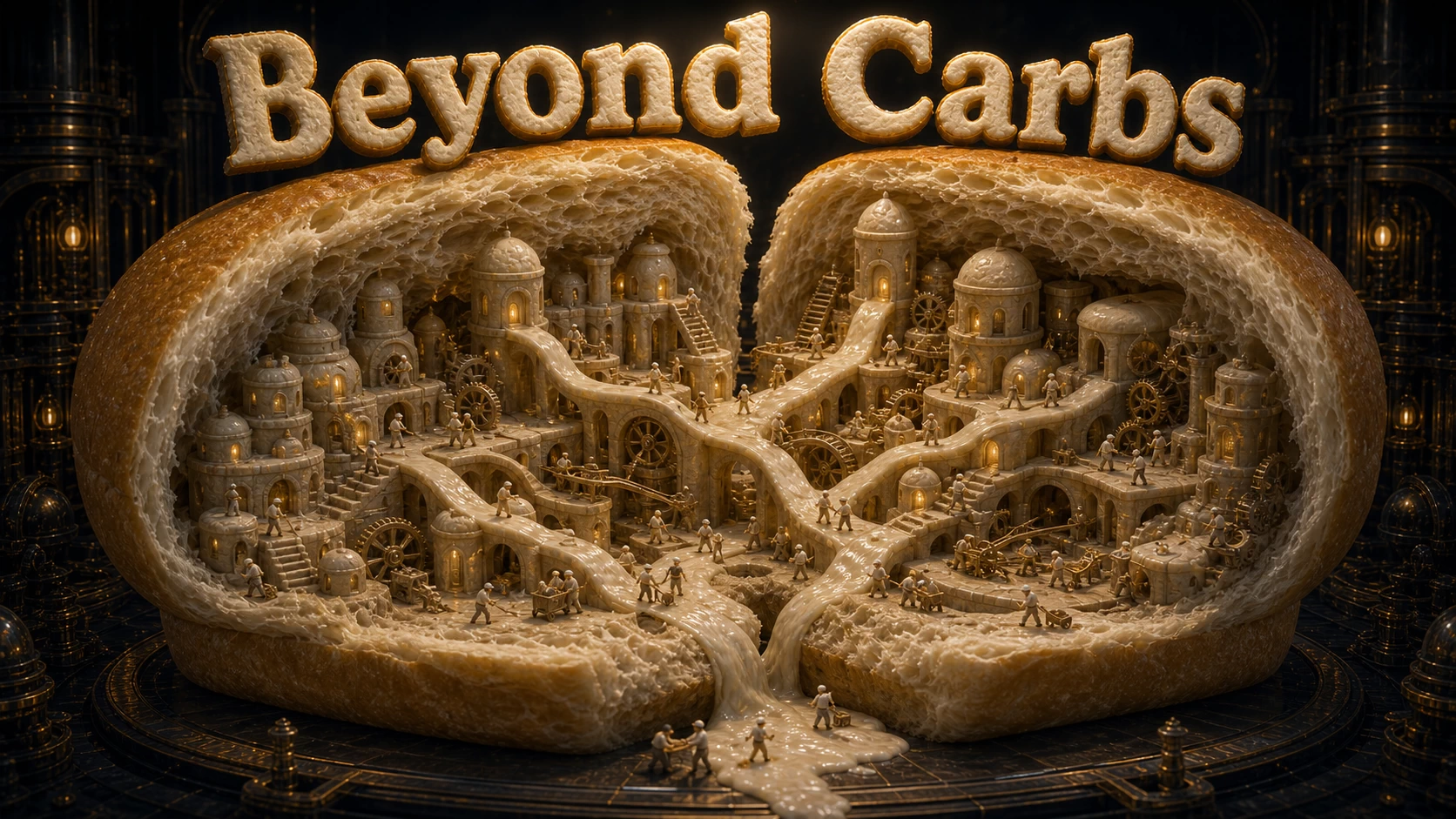
Because it looks so simple, people usually describe it with one lazy word: carbs. But your body is not lazy. Your body does not receive “carbs” as a spreadsheet category. It receives a physical food with a structure, speed, texture, processing history, and repeated signal. White bread is not just carbs. It is refined dough, and your body reads the whole journey.

White bread is not just carbs. It is refined dough — and your body reads the structure, speed, processing, and repetition.
That journey may feel different from rice, potatoes, fruit, intact grains, or true whole-grain bread, even when all of them are pushed into the same simple category: carbohydrates. That is the mistake. The body does not eat the category. The body eats the form.
Quick Answer: Why White Bread Is Not Just Carbs
White bread is not just carbs because it is a refined dough matrix. It is made from flour that has been processed, stripped of much of the original grain structure, mixed into dough, baked into a soft porous food, and often eaten quickly and repeatedly. Inside the body, that means more than starch grams. It means texture, starch accessibility, lower fiber, chewing speed, gut response, glucose response, processing, additives in some packaged breads, and daily repetition.
This does not mean one slice of white bread is poison. It means calling it “just carbs” is too shallow. A food can be simple on the plate and still create a complex journey inside the body.

The Problem With Calling White Bread “Just Carbs”
Nutrition labels are useful, but they can flatten reality. They may tell you grams of carbohydrates, protein, fat, sugar, fiber, and calories. What they do not fully show is what the food becomes after it enters the mouth, stomach, small intestine, colon, liver, bloodstream, and daily routine.
White bread is usually treated as a math problem. How many carbs? How many calories? How much sugar? How much fiber? Those questions matter, but they are not enough. The deeper question is: what form is the body actually receiving?
Two foods can both be “carbs” and still behave differently inside the body. Rice is not bread. Potatoes are not bread. Whole grains are not white flour. A slice of industrial white bread is not the same journey as an intact food that still carries more of its original structure. The category may be similar. The body experience is not.
The Body Does Not Receive Starch. It Receives Refined Dough.
White bread begins with wheat, but it does not reach you as wheat. It reaches you as flour, and that matters. White flour is created by removing much of the bran and germ of the grain, leaving mostly the starchy endosperm. That changes more than nutrients. It changes the physical structure of the food.
Then flour becomes dough. Dough is not loose starch floating around. It is a network. It contains starch, gluten structure, water, trapped air, and a texture that changes how the food breaks down. Once baked, white bread becomes soft, airy, and easy to eat quickly. That softness is part of its appeal, but softness in the mouth does not always mean quietness in the gut.
Soft in the mouth does not always mean quiet inside the body.
The body has to deal with the refined dough mass, not the comforting image of a soft slice.
What Refining Removes From the Grain
When wheat is refined into white flour, the grain loses much of its original complexity. The bran is reduced. The germ is removed or greatly reduced. Fiber drops. Some minerals, plant compounds, oils, and protective structures are lost. Fortification can add back certain nutrients, but it does not fully rebuild the original food architecture.
This is a key point. The issue is not only that white bread may contain less fiber or fewer micronutrients than whole-grain bread. The bigger issue is that the grain has been changed from a structured seed into a fine flour that becomes soft refined dough.
Refining does not only change nutrients. It changes the structure the body has to handle.
That structure can affect chewing, digestion, glucose availability, fullness, gut movement, and the way the food feels after eating.
Why Structure Matters More Than People Think
Imagine two buildings made from the same material. One is a solid brick wall. The other is powder in a bag. Same source, different structure, completely different behavior. Food works like that too.
A whole grain, a cracked grain, a coarse flour, a fine flour, and a soft white loaf are not the same biological experience. The body does not only see the chemical composition. It also deals with the structure. In food science, this is often called the food matrix. In simple language, it means the form of the food changes what the food does.
White bread is a refined matrix. Its starch is generally more accessible than starch trapped inside more intact food structures. That can make digestion faster for many people, especially when white bread is eaten alone, eaten quickly, or eaten in large amounts.
This is why “carbs are carbs” is such a weak sentence. Your gut knows better.
White Bread and the Fast Signal Problem
White bread is often used as a reference food in glycemic index testing because it can produce a relatively fast blood glucose response in many people. That does not mean everyone reacts the same way. Human responses vary a lot, and the microbiome, sleep, insulin sensitivity, meal size, activity, stress, and what you eat with the bread can all change the response.
Still, the general idea matters: a soft slice can feel easy in the mouth and still create a fast signal inside the body. That fast signal may be part of why some people feel hungry again soon after white bread, or feel sleepy, heavy, foggy, or oddly unsatisfied after a bread-heavy meal.
This is not about blaming one slice for every metabolic problem. It is about understanding the signal. White bread does not arrive like a slow, intact grain. It arrives as a refined dough that the body can often break down quickly.
Why White Bread May Feel Different From Rice or Potatoes
People often ask a useful question: why can I eat rice or potatoes and feel fine, but white bread makes me bloated, sleepy, or heavy? The answer is not only “carbs.” Rice, potatoes, and white bread are all carbohydrate-rich foods, but they do not arrive in the same form.
Rice is a grain cooked mostly as separate pieces. Potatoes are a whole plant storage organ with a different water content, texture, chewing experience, and starch structure. White bread is refined flour transformed into soft dough. The body reads food form, particle size, water content, chewing demand, fiber and structure, starch accessibility, fermentable components, processing, and meal context.
The real question is not which food has carbs. The real question is which journey your body handles more quietly.
The Softness Trap: Easy to Eat Is Not Always Easy to Process
White bread is easy to eat, and that is part of its trick. Soft foods usually require less chewing. Less chewing can mean faster eating. Faster eating can mean less oral processing, weaker early satiety signals, and a larger amount of food reaching the stomach before the body clearly says, “Enough.”
This does not make white bread evil. It makes it sneaky. It enters quietly, disappears quickly, and does not demand much effort from the mouth. But after swallowing, the body still has to process the refined dough. For some people, that can feel like heaviness, fullness, bloating, reflux, sleepiness, quick hunger rebound, or a “stuck” feeling after sandwiches and toast.
White Bread and Bloating: It Is Not Always Gluten
When people bloat after bread, gluten usually gets blamed first. Sometimes gluten-related disease is real and serious. Celiac disease and wheat allergy need proper medical evaluation. Some people also report non-celiac wheat or gluten sensitivity. But bloating after bread is not always a gluten story.
Wheat also contains fructans, a type of fermentable carbohydrate in the FODMAP family. In sensitive guts, especially in IBS, fructans can reach the colon and be fermented by bacteria, producing gas and bloating. This is why some people who think they are reacting to gluten may actually be reacting to wheat fructans, the full bread matrix, the meal context, or a sensitive gut response.
Bloating after white bread is not always about one villain. Sometimes the whole dough story is involved.
The bread, the filling, the speed of eating, the amount, the gut state, and the daily repetition all matter.
White Bread May Be Lower in Fiber, But That Does Not Always Mean Easier
Some people feel less gas with white bread than whole wheat bread because whole wheat contains more fiber and more fermentable components. That can be true for certain sensitive guts. But lower fiber does not automatically mean better.
Fiber is not just bulk. It also feeds parts of the gut microbiome, supports stool movement, and helps create short-chain fatty acids when fermented by beneficial microbes. White bread often gives the gut less of that support because much of the original grain structure has been removed.
So white bread may sometimes feel easier in the short moment, while still being a weaker daily signal for gut ecology when it becomes the main repeated bread choice. That is the nuance: whole grain can bother some guts, white bread can still be a poor daily pattern, and the body decides by response, not reputation.
Whole Grain Bread Is a Different Journey, Not a Magic Solution
Whole-grain bread keeps more of the original grain structure. It usually contains more fiber, more minerals, more plant compounds, and a different digestion pattern than white bread. That can be useful for many people, but “whole grain” is not a magic spell.
Some whole-grain breads are still industrial products. Some are mixed with refined flour. Some are colored or marketed to look healthier than they are. Some sensitive guts may bloat more from whole wheat because of fiber, fructans, or gut hypersensitivity.
The Tayibat question is not “whole grain always good and white bread always bad.” The better question is: what journey does this bread create inside this body? Whole grain is a different journey, but benefit still needs tolerance.
Packaged White Bread Adds Another Layer
There is a big difference between simple bread and modern packaged white bread. Many packaged breads are designed to stay soft, consistent, cheap, and shelf-stable. That may involve emulsifiers, preservatives, dough conditioners, softeners, added sugars, oils, and other processing aids.
This does not mean every additive is toxic or every packaged bread is dangerous. That would be careless. But it does mean packaged bread can carry a processing layer beyond flour, water, yeast, and salt.
Packaged bread is often not just bread. It is bread plus a system designed to keep it soft, stable, and repeatable.
Some emulsifiers and additives are being studied for possible effects on the gut microbiome and intestinal barrier. Much of the stronger experimental evidence comes from animal or laboratory studies, while human evidence is still developing. So the right tone is not panic. The right tone is attention.
Daily White Bread: When One Slice Becomes a Repeated Signal
One slice is rarely the real story. The real story is repetition. White bread often appears as toast in the morning, a sandwich at work, burger buns, fino-style rolls, white toast, pizza dough, crackers, bread beside meals, or late-night bread snacks. So the body is not always handling a rare slice. It may be handling a daily refined-dough pattern.
One slice is not the whole story. The daily pattern is where the signal gets louder.
From the Tayibat view, repetition matters because the body lives in patterns, not isolated moments. A repeated food can become a repeated digestive signal, repeated glucose signal, repeated gut signal, repeated craving signal, and repeated displacement of foods the body may handle better.
That is why the question is not only: can I eat white bread? The deeper question is: what happens when refined dough becomes part of my body’s daily routine?
White Bread and Energy: Why Some People Feel Tired After Eating It
Some people feel sleepy or foggy after white bread, especially when the meal is large or built mostly around refined bread. A refined bread-heavy meal may create a faster glucose response in many people. In some cases, this may be followed by a dip in energy, hunger, or sleepiness.
The meal may also be low in fiber and low in longer-lasting satiety signals. If the bread is paired with fried fillings, processed meats, cheese, sauces, or eaten late, the heaviness may come from the whole meal rather than bread alone. Do not blame one ingredient before reading the whole plate. Your body is not reacting to a textbook definition. Your body is reacting to a meal.
Why Your Personal Response Matters
Average nutrition advice often speaks as if all bodies respond the same way. They do not. Studies on bread and glycemic response show that people can respond differently to the same bread. The gut microbiome, baseline metabolism, lifestyle, sleep, stress, and meal context can all change what happens after eating.
This is one reason the Tayibat approach cares so much about body signals. Not because every symptom is a diagnosis, but because repeated signals are information. If white bread repeatedly leaves you bloated, sleepy, refluxy, foggy, hungry again quickly, or heavy, your body may be giving you useful feedback.
When symptoms repeat after the same food, the question is not fear. The question is attention.
The Tayibat View: The Body Reads the Journey, Not the Label
In Tayibat, we do not ask only how many carbs, how many calories, or how much starch. We ask what form the food entered in, whether it was refined or intact, whether it was soft enough to overeat quickly, whether it passed quietly, whether it created bloating or reflux, whether it left energy or fatigue, whether it fed the gut well or repeated a low-fiber signal, and whether it came as simple food or packaged processing.
This is the difference between nutrition math and body reading. White bread is not judged only because it contains carbohydrates. It is judged because of the journey it creates. The body reads structure, speed, processing, texture, gut tolerance, and repetition. That is much bigger than “carbs.”
How to Think About White Bread Without Panic
The point is not to fear a slice of bread. The point is to stop pretending the slice is biologically invisible. A more intelligent way to think about white bread is to ask how often you eat it, how much you eat, whether you feel different afterward, whether it makes you bloated or heavy, whether you feel hungry again quickly, and whether it replaces foods that feel calmer in your body.
Also look at the full context. Is it simple bread or heavily processed packaged bread? Does it come with fried, processed, or heavy fillings? Does your body handle rice, potatoes, or whole foods better? This is not diet culture. This is body awareness.
When to Be More Careful
You should take symptoms more seriously if bread or wheat repeatedly causes severe bloating, pain, diarrhea, constipation, fatigue, reflux, skin symptoms, wheezing, hives, swelling, or symptoms after most meals. You should also speak with a clinician if you have unexplained weight loss, blood in stool, persistent vomiting, difficulty swallowing, iron-deficiency anemia, chronic diarrhea, severe abdominal pain, a family history of celiac disease, known autoimmune disease, diabetes, pregnancy, kidney disease, chronic medication use, or a history of eating disorders.
If you suspect celiac disease, do not remove gluten before medical testing unless your clinician tells you to. Celiac blood tests and biopsies usually require ongoing gluten exposure to be accurate. This article is educational. It does not diagnose, treat, or replace medical care.
FAQ: White Bread Is Not Just Carbs
Is white bread just carbs?
No. White bread contains carbohydrates, but inside the body it behaves as a refined dough matrix. Its texture, flour structure, processing, fiber loss, starch accessibility, and repetition all affect the journey.
Why does white bread feel different from rice or potatoes?
Because the food form is different. White bread is made from refined flour and baked into soft dough. Rice and potatoes have different structures, water content, chewing demands, and digestion patterns. The body reads form, not only carbohydrate grams.
Does white bread spike blood sugar?
White bread can produce a faster glucose response in many people, especially when eaten alone or in large amounts. Individual responses vary depending on microbiome, insulin sensitivity, sleep, stress, activity, and meal context.
Can white bread cause bloating?
It can contribute to bloating in some people. The reason may involve wheat fructans, gut sensitivity, IBS, meal size, dough texture, eating speed, or the foods eaten with the bread. It is not always gluten alone.
Is gluten always the problem with white bread?
No. Gluten can be a serious issue for people with celiac disease or wheat-related disorders, but bloating after bread is often related to fructans, FODMAPs, gut sensitivity, or the full meal context.
Is whole-grain bread always better?
Whole-grain bread is a different journey because it keeps more of the grain structure and usually contains more fiber and nutrients. But it can still bother sensitive guts because of fiber, fructans, or individual tolerance. Benefit still needs tolerance.
Is packaged white bread worse than homemade bread?
Packaged bread may include additives, emulsifiers, preservatives, dough conditioners, oils, or sweeteners that add another processing layer. This does not mean every packaged bread is dangerous, but it does mean the body may be receiving more than flour, water, yeast, and salt.
Should I stop eating white bread completely?
Not automatically. The smarter first step is to observe your body’s pattern: how often you eat it, how much, what you eat with it, and what symptoms repeat. If symptoms are persistent or severe, speak with a healthcare professional.
Keep Reading
Final Thought
White bread looks simple because it has been made simple. That is exactly why the body may read it differently. The grain lost structure. The flour became refined. The dough became soft. The slice became easy to eat. The starch became more available. The pattern became daily.
So no, white bread is not just carbs. It is refined dough, and your body reads the structure, speed, processing, and repetition.
The better question is not only how many carbs are in this slice. The better question is what journey this refined dough is asking your body to handle.